

Prerequisites
Before reading this, you should understand:- AMM Fundamentals - Constant product formula (x×y=k) and basic trading mechanics
- Capital Efficiency Crisis - Why traditional AMMs waste 99.5% of liquidity
- CLMM: Concentrated Liquidity Market Makers - Custom price ranges and 4,000x efficiency gains
Key Concepts You’ll Learn
- Zero-slippage bins: How discrete price ranges eliminate slippage within specific ranges
- Capital efficiency gains: Real data showing 200x-25,000x improvements over traditional AMMs
- Three distribution strategies: Spot/Flat, Curve, and Bid-Ask approaches for different market conditions
- Dynamic fee systems: How fees adjust based on volatility and bin utilization
CLMM vs DLMM: The Critical Difference
CLMM’s Remaining Problem
While CLMM (like Uniswap V3) solved capital efficiency through custom price ranges, it still has slippage within those ranges due to the x×y=k formula: CLMM Limitations:DLMM’s Revolutionary Solution
DLMM eliminates slippage entirely within discrete bins by using A+B=C formula instead of x×y=k: DLMM Innovation:- Traditional AMM: Uniform distribution + slippage everywhere
- CLMM: Custom ranges + slippage within ranges
- DLMM: Discrete bins + zero slippage within bins
DLMM Architecture: Zero-Slippage Bins
Discrete Price Bins Replace Continuous Curves
DLMM divides liquidity into discrete zero-slippage price bins, each representing a specific price point rather than a continuous range. Key Innovation: Each bin uses the formulaA + B = C instead of x × y = k
The Active Bin System
Active Bin: Only one bin is active at any time - it:- Contains both Token A and Token B
- Earns all trading fees
- Processes swaps with zero slippage
- Shifts when liquidity is exhausted
Dynamic Fee System
DLMM implements variable fees that change with market volatility, measured by bins crossed and swap frequency: Volatility-Based Adjustments:- More bins crossed = higher volatility detected
- Fees automatically increase during volatile periods
- LPs compensated for increased impermanent loss risk
- LPs protected during extreme market conditions
- Traders pay fair prices based on market stress
- Protocol captures more value during high-volatility periods
Proven Capital Efficiency Gains
Real Performance Data
Based on Uniswap V3 research and DLMM implementations, concentrated liquidity achieves documented improvements: Maximum Theoretical Gains:- 4,000x improvement: Single 0.10% price range concentration
- 25,000x improvement: Maximum 0.02% range concentration
- 200x improvement: Practical stablecoin concentration (0.99-1.01 range)
Three Distribution Strategies
DLMM supports flexible liquidity strategies based on market conditions and LP preferences:1. Spot/Flat Distribution
Best for: Maximum fee capture in active markets Mechanism: Evenly distributes liquidity across chosen price range Use case: ETH trading between 2,100Risk: Broad exposure to volatility Reward: Maximum fee potential within selected range
2. Curve Distribution
Best for: Stable markets with predictable ranges Mechanism: Concentrates more liquidity near current price using curve weighting Use case: Stablecoin pairs (USDC/USDT) expecting minimal movement Risk: Lower than flat distribution Reward: Optimized for low-volatility conditions3. Bid-Ask Distribution
Best for: Dollar-cost averaging strategies Mechanism: Focuses liquidity provision around current market price Use case: Gradual position entry/exit without market impact Risk: Concentrated impermanent loss Reward: Efficient capital deployment for DCA strategies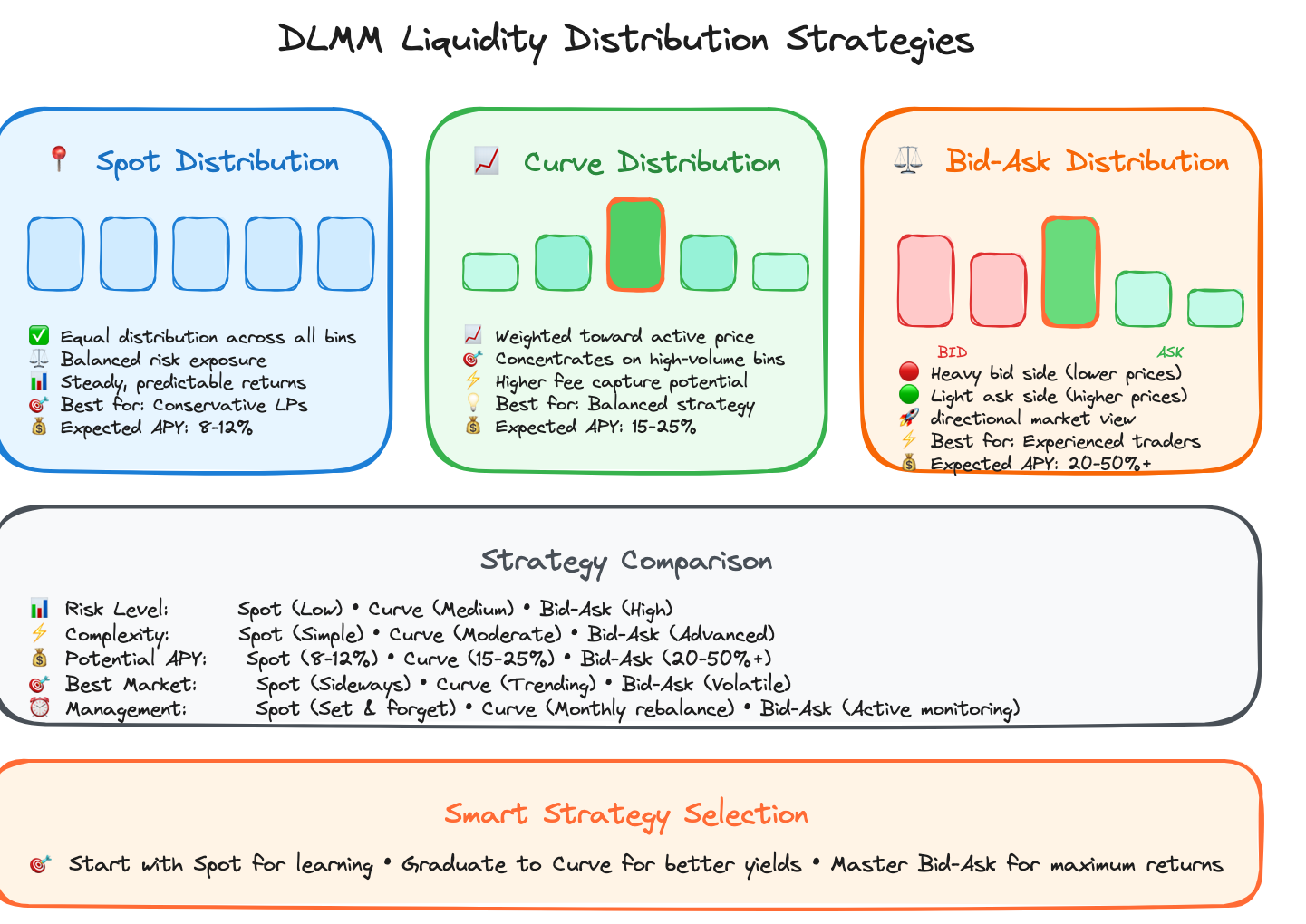
Risk-Return Comparison
Concentrated vs Traditional LP Returns:DLMM Design Innovations
Bin Array Architecture
DLMM organizes bins into arrays for efficient on-chain storage and retrieval: Packed Storage: Multiple bins are stored together in single accounts to reduce storage costs. Lazy Initialization: Bin arrays are only created when needed, reducing upfront costs. Efficient Queries: Bin data can be retrieved in batches, reducing RPC calls and improving performance.Price Discovery Mechanism
DLMM maintains accurate price discovery through its bin structure: Current Active Bin: The bin containing the current market price, where most trading occurs. Bin Traversal: As trades exhaust liquidity in the current bin, the active bin shifts to the next price level. Liquidity Aggregation: Large trades automatically aggregate liquidity across multiple bins to minimize price impact.Economic Implications
For Liquidity Providers
Strategic Positioning: LPs can choose specific price ranges based on their market outlook and risk tolerance. Fee Optimization: Concentrated liquidity in high-activity ranges generates more fees per unit of capital. Position Management: LPs must actively manage positions as market conditions change.For Traders
Better Execution: Concentrated liquidity provides better prices for trades, especially larger ones. Predictable Costs: More efficient liquidity leads to more predictable trading costs. Market Depth: True market depth becomes more visible through bin liquidity distribution.For Protocols
Competitive Advantage: Protocols using DLMM can offer better trading experiences, attracting more volume. Liquidity Incentives: More efficient liquidity means protocols need fewer incentives to achieve the same trading quality. Composability: DLMM pools can be more easily integrated into complex DeFi strategies.Implementation Considerations
Technical Trade-offs
Complexity vs Efficiency: DLMM’s improved capital efficiency comes at the cost of increased implementation complexity. Gas Costs: More sophisticated logic can lead to higher transaction costs, though this is often offset by better execution. State Management: Tracking bins, positions, and fee accrual requires more sophisticated state management.User Experience Design
Position Visualization: Users need clear interfaces to understand their position ranges and performance. Risk Communication: The implications of concentrated liquidity positions must be clearly communicated. Management Tools: Users benefit from tools that help them optimize and rebalance positions.Future Evolution
Integration Trends
Multi-Protocol Aggregation: DLMM pools are increasingly integrated into DEX aggregators for optimal routing. Yield Strategies: Sophisticated yield farming strategies are built on top of concentrated liquidity positions. Institutional Adoption: Professional market makers are adopting concentrated liquidity for more efficient capital deployment.Technical Advancement
Cross-Chain Implementation: DLMM concepts are being adapted for different blockchain architectures. Advanced Fee Models: More sophisticated fee structures that better align LP and trader incentives. Automated Management: Tools for automated position management and rebalancing are becoming more prevalent.Market Adoption and Performance
Real-World Success Metrics
Meteora DLMM Performance (2024):- 675,000+ wallets actively using DLMM pools
- 10,000-30,000 daily users including 4,000-8,000 new users daily
- 5x trading volume compared to traditional AMM equivalents
- Jupiter integration: Successful routing through Solana’s primary aggregator
- Professional market makers achieving 50-200%+ APY
- Protocols using DLMM for token launches with single-sided liquidity
- Advanced strategies replacing traditional limit orders
When Concentrated Liquidity Excels
Ideal Use Cases:- High-volume trading pairs: ETH/USDC, SOL/USDC with predictable activity ranges
- Professional market making: Sophisticated LPs willing to actively manage positions
- Capital-constrained LPs: Smaller providers achieving competitive returns with less capital
- Stablecoin pairs: Extreme efficiency gains for narrow trading ranges
- Long-tail assets: Unpredictable price discovery phases
- Set-and-forget LPs: Users preferring passive strategies
- Extremely volatile pairs: Where ranges are impossible to predict
Key Takeaways
Concentrated Liquidity Advantages:- Proven efficiency: 200x-25,000x capital efficiency improvements
- Zero slippage bins: Better execution within price ranges
- Dynamic fees: Automatic volatility protection
- Flexible strategies: Three distribution approaches for different goals
- Understanding of price range prediction
- Active position management capability
- Risk tolerance for concentrated impermanent loss
- Tools and interfaces for optimization
Next Steps
After mastering concentrated liquidity fundamentals, explore:- Bin Architecture Deep Dive - Technical implementation of discrete bins and storage optimization
- Traditional vs DLMM Decision Guide - When to choose concentrated liquidity for your specific use case
- Implementation Technology Choice - Selecting the right SDK for your project needs