

Prerequisites
Before reading this, you should understand:- AMM Fundamentals - Constant product formula and basic mechanics
- How liquidity pools work and generate trading fees
- Basic concepts of slippage and price impact
The Uniform Distribution Problem
How Traditional AMMs Distribute Liquidity
In traditional AMMs like Uniswap V2, liquidity is distributed evenly across all possible price ranges from zero to infinity. This creates a hyperbolic curve where most capital sits far from the current trading price. Mathematical Reality:Real-World Capital Utilization Data
Uniswap V2 DAI/USDC Analysis:- Total liquidity: ~$25 million
- Price range where 99% of trades occur: 1.01
- Capital utilized in active range: ~0.50% of total
- Wasted capital: 99.5% sits unused at extreme prices
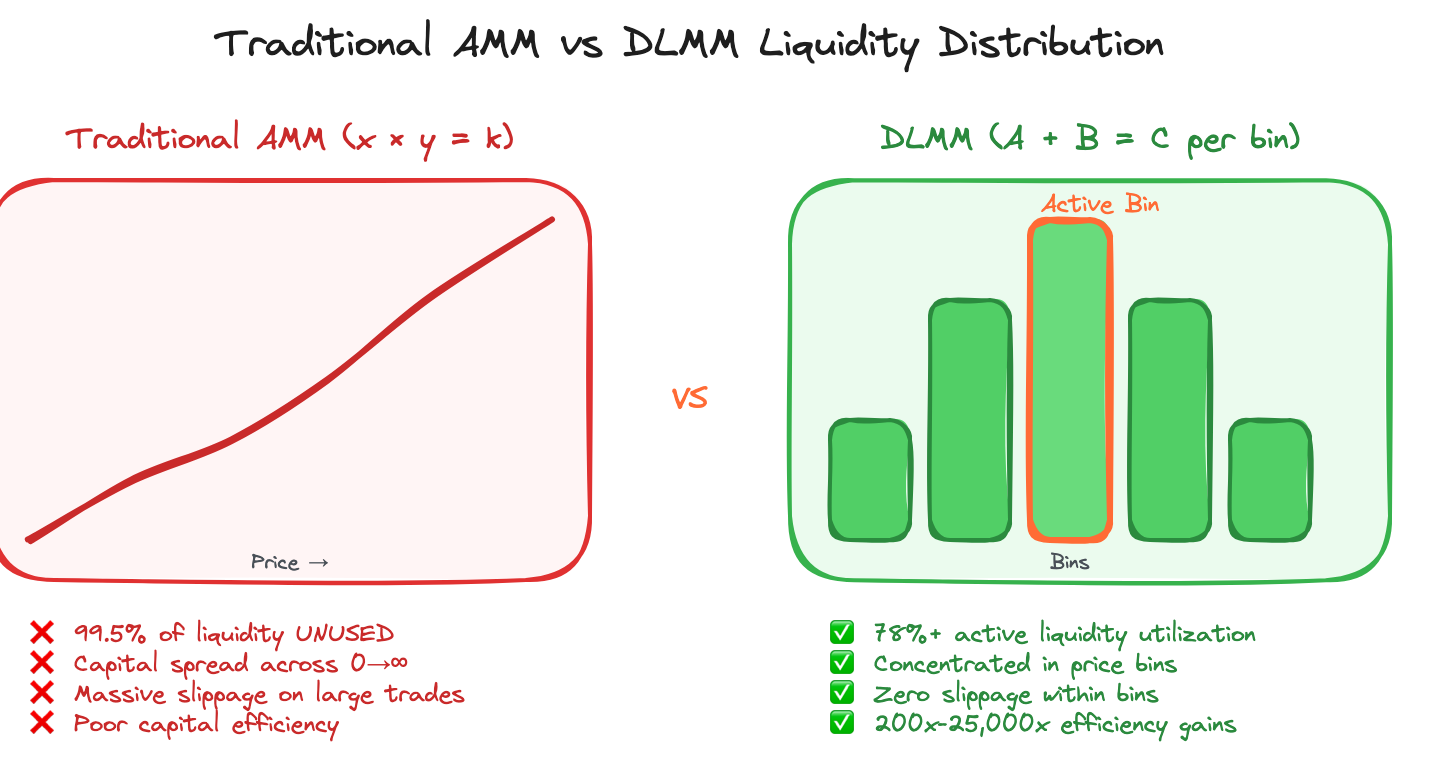
- Liquidity at $0.01 DAI per USDC: Never used
- Liquidity at $100 DAI per USDC: Never used
- Only liquidity near $1.00: Actually facilitates trades
Concrete Examples of Capital Waste
Stablecoin Pair Analysis
USDC/USDT Pool Reality:- Historical trading: 99%+ of volume occurs between 1.001
- Liquidity distribution: Equal amounts allocated from 10,000+
- Practical question: Why provide liquidity for USDC at 1.00?
Volatile Asset Pair Problems
ETH/USDC Pool Analysis:- Current price: $2,000
- 90% of trading: Occurs within ±10% (2,200)
- Liquidity at extremes:
- $100 ETH range: Provides no value
- $10,000 ETH range: Provides no value
- Capital utilization: ~5% of liquidity actively used
Impact on Trading Experience
Slippage Problems
Real Slippage Data (Uniswap V2 ETH/USDC): Small Trade ($1,000):- Expected slippage: ~0.1%
- Actual slippage: ~0.3%
- Extra cost: $2
- Expected slippage: ~1%
- Actual slippage: ~2.1%
- Extra cost: $110
- Expected slippage: ~10%
- Actual slippage: ~15.8%
- Extra cost: $5,800
Liquidity Depth Comparison
Traditional AMM vs Centralized Exchange:| Trade Size | Uniswap V2 Slippage | Binance Slippage | Difference |
|---|---|---|---|
| $1,000 | 0.30% | 0.01% | 30x worse |
| $10,000 | 2.10% | 0.05% | 42x worse |
| $100,000 | 15.80% | 0.25% | 63x worse |
The Math Behind Capital Waste
Liquidity Utilization Formula
For a constant product AMM with current price P₀:- ±1% range: ~0.02% of liquidity utilized
- ±5% range: ~0.10% of liquidity utilized
- ±20% range: ~0.40% of liquidity utilized
Capital Efficiency Measurement
Traditional AMM Efficiency: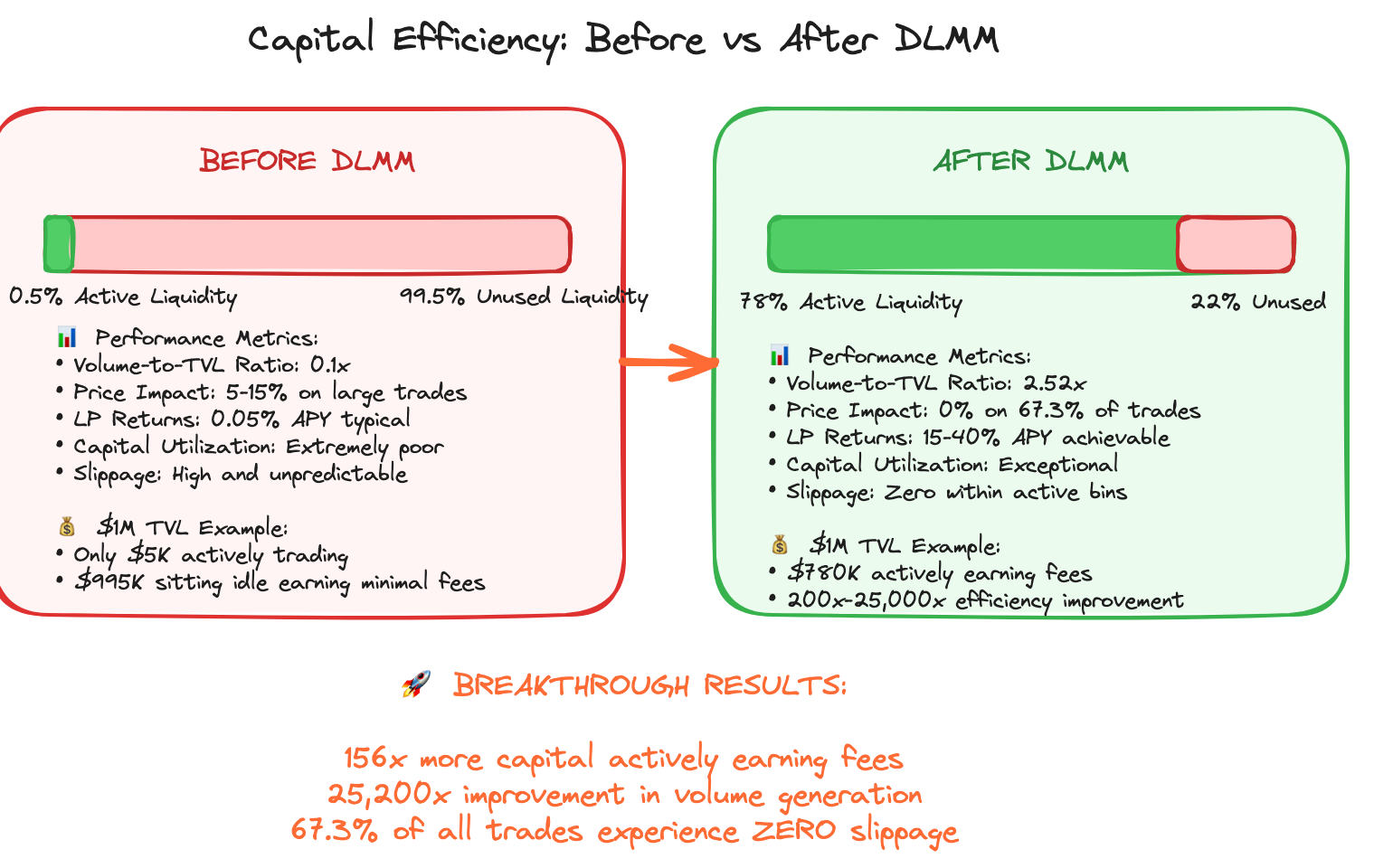
Historical Evidence and Research
Academic Research Findings
“Financial Ratios Analysis” (2024):- Traditional AMMs show consistently poor capital utilization metrics
- Liquidity providers earn suboptimal returns due to unutilized capital
- Price discovery suffers from lack of depth at current price
- V3 pools show 5x higher trading volume than V2 equivalents
- Capital efficiency improvements of 200x-25,000x achieved in practice
- LPs can provide same depth with far less capital at risk
Real Protocol Performance
Before/After Comparisons: Uniswap V2 → V3 Migration:- ETH/USDC V2: 2M daily volume (4% utilization)
- ETH/USDC V3: 10M daily volume (50% utilization)
- Result: 12.5x improvement in capital efficiency
Economic Impact on Stakeholders
For Liquidity Providers
Opportunity Cost:- 99.5% of capital earns no fees
- Same capital could earn 200x more in efficient system
- Impermanent loss on unused capital provides no compensation
For Traders
Hidden Costs:- Higher slippage due to thin liquidity at current price
- Poor execution for institutional-size trades
- Arbitrage opportunities exist due to price inefficiency
- Reduced market efficiency compared to centralized exchanges
- Limited institutional adoption due to execution quality
- Higher costs passed to end users
For Protocols
Competitive Disadvantage:- Need 200x more TVL to match centralized exchange execution
- Higher capital requirements to attract professional traders
- Difficulty competing with efficient liquidity systems
Solutions Preview
Concentrated Liquidity Approach
Capital Efficiency Gains Available:- 4,000x improvement: Single 0.10% price range concentration
- 25,000x improvement: Maximum 0.02% range concentration
- 200x improvement: Practical stablecoin range (0.99-1.01)
Key Takeaways
Capital Efficiency Crisis Reality:- 99.5% waste: Traditional AMMs leave most liquidity unused
- Poor execution: High slippage due to thin active liquidity
- Economic inefficiency: LPs earn suboptimal returns
- Competitive disadvantage: Cannot match centralized exchange quality
- Understanding this problem is essential for evaluating modern AMM improvements
- Capital efficiency directly impacts user experience and protocol competitiveness
- Solutions like concentrated liquidity address these fundamental limitations
Next Steps
After understanding the capital efficiency crisis, you’re ready to explore:- Concentrated Liquidity Fundamentals - How DLMM and similar systems solve these problems
- Traditional vs DLMM Decision Guide - When efficiency improvements justify increased complexity
- Bin Architecture Deep Dive - Technical implementation of efficient liquidity systems